Archived edition · View the latest edition
“Over asking” describes a comparison with a price chosen for a listing. To understand a sale, you also need the original ask, the sale price and comparable properties. The label alone does not establish that a buyer overpaid or that a seller achieved their original target.
What the Q3 records show
The study uses sold listing episodes with purchase-contract dates from July 1 through September 30, 2026. “Recorded asking” means the listing-price field in the saved sold record. We have not independently verified that it was the final price advertised to buyers.
| Measure | Episodes | Share and denominator |
|---|---|---|
| Eligible sold episodes with all three prices | 2,627 | Study sample |
| Sold above recorded asking | 315 | 12.0% of 2,627 |
| Above recorded asking, but below original asking | 23 | 7.3% of 315; 0.9% of 2,627 |
| Above recorded asking, and at or above original asking | 292 | 92.7% of 315 |
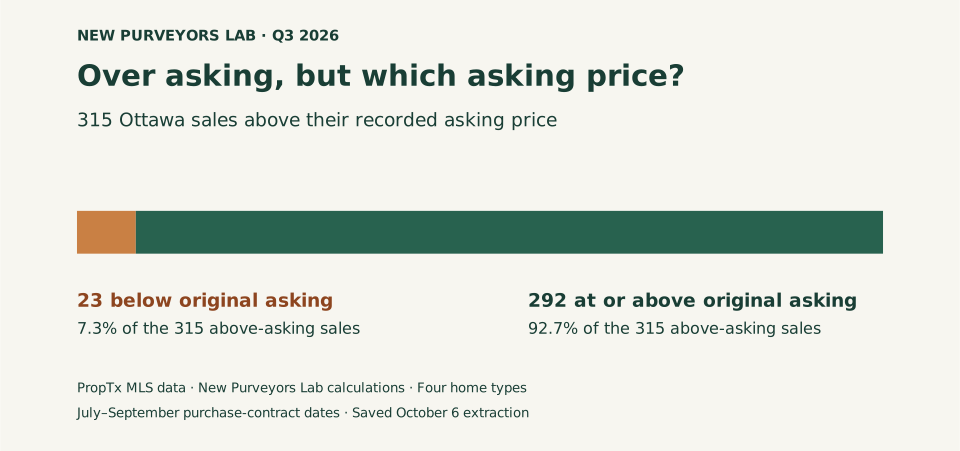
Most above-asking sales in this sample also reached or exceeded the original ask. The smaller group of 23 shows why the reference price still matters. The two statements “sold over asking” and “sold below the original ask” can both accurately describe the same recorded sale.
This is a strict comparison. A sale exactly at the recorded ask is not counted as above it. A sale exactly at the original ask is not counted as below it.
How it varied by home type
| Home type | All eligible sales | Above recorded asking | Also below original asking | Share of above-asking sales |
|---|---|---|---|---|
| Detached | 1,252 | 189 | 14 | 7.4% |
| Freehold townhouse | 692 | 78 | 7 | 9.0% |
| Apartment condo | 397 | 31 | 1 | 3.2% |
| Condo townhouse | 286 | 17 | 1 | Not reported |
The final column uses each type's above-asking count, not its total sales. We do not report the condo-townhouse percentage because that denominator is only 17, below the Lab's minimum of 30 for an MLS percentage. The apartment-condo result clears that threshold but rests on just one qualifying episode; it is not a dependable ranking of pricing strategies.
What a buyer can do with this
When an above-asking sale is offered as a comparable, ask to see the actual sale price alongside both asking prices. Then compare the property's condition, location and features with the home you are considering. An above-asking label cannot do that comparison for you.
The original ask adds context, but it is not an independent valuation either. A sale below that figure does not by itself prove a bargain. Equally, a sale above the recorded ask does not prove a bidding war: this dataset does not establish how many offers were received.
What a seller can do with this
Ask for comparable results expressed in sale dollars as well as asking-price percentages. A useful pricing discussion should explain the reference price behind each percentage and how closely the comparable resembles your property.
These records cannot tell a seller that reducing an ask will improve the eventual result. They contain completed recorded sales, not every attempt to sell, and they do not reconstruct the full sequence of price changes. Choosing a strategy requires information beyond this intersection of three prices.
Source, method and limits
Source: PropTx MLS data, with calculations by New Purveyors Lab. This analysis reuses a saved October 6, 2026 extraction; it is a completed-quarter study, not a current inventory report. Geography is the provider's Ottawa county/region field across supplying boards, not a separately mapped municipal boundary.
The broader Q3 extraction contained 2,905 residential sold episodes. We selected the four home types shown above, leaving 278 other-type episodes outside this study. All 2,627 selected episodes had positive sale, recorded asking and original asking prices; none was excluded for a missing or nonpositive price. A listing episode is the unit of analysis. Relistings have not been linked into unique homes.
Purchase-contract date determines the quarter; closing date does not. The calculation compares sale price with recorded asking and original asking using the strict inequalities described above. Counts and percentages were independently recalculated from the preserved source pages. Results are rounded for display only.
The sample cannot measure the probability of selling, a causal benefit from price changes, seller profit or buyer overpayment. This Q3 edition also should not be compared with the prior annual edition as though a change between their percentages measured a market trend: the periods differ and overlap.
For complementary questions, see Ottawa sales below asking, asking-price reductions and buyer competition. The Lab's research standards explain its evidence rules.
For a property-specific discussion with Matt Richling and New Purveyors, bring the sale price and both asking prices. They give a more useful starting point than an “over asking” headline alone.
Earlier edition: Read the prior study and its original methods.
Discuss these findings
For help applying these findings to a property or a move, contact Matt Richling. Include the area, property type and timing that matter to you.
Cite this edition
Richling, Matt. “How often did “over asking” still mean below the original asking price in Ottawa?” New Purveyors Lab. Q3 2026 · July–September. Updated October 24, 2026. Permanent edition.