For someone interviewing an Ottawa agent, the findings suggest a useful test: can the agent show how their work will help you make the difficult decisions in your move?
The priorities behind the transaction
The study asked respondents to rank the services they considered most valuable. These were the leading three first-place choices for each side of a transaction.
| Buyer service | Share ranking it first |
|---|---|
| Finding the right home | 32.7% |
| Understanding comparable home prices | 18.1% |
| Negotiating the purchase price | 16.5% |
| Seller service | Share ranking it first |
|---|---|
| Pricing the home competitively | 28.6% |
| Marketing the home | 21.7% |
| Negotiating with buyers | 15.6% |
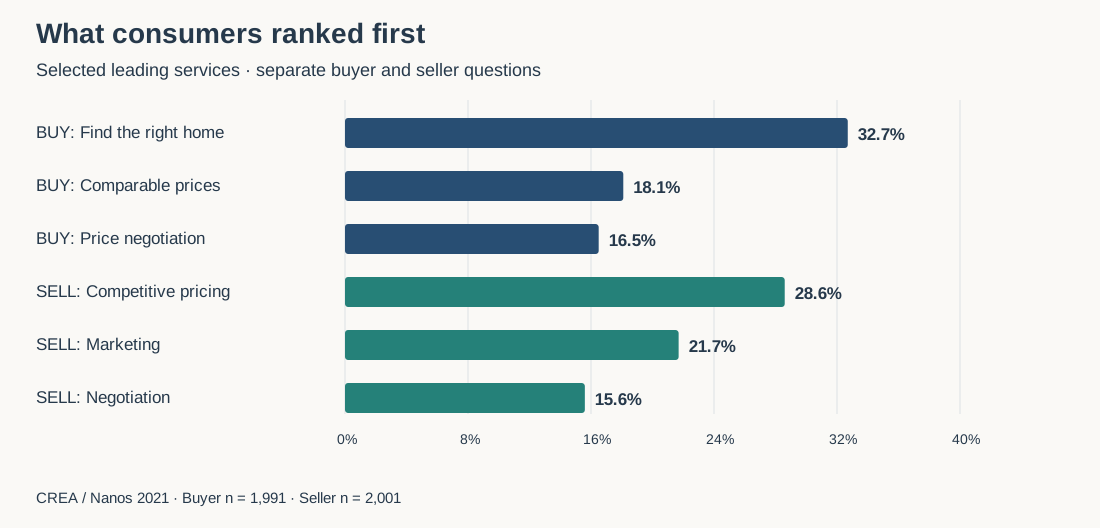
Buyer-question base: 1,991. Seller-question base: 2,001. These are selected leading responses; a service chosen second or third is not counted in its first-place share.[1]
The buyer’s task begins with selection: deciding which property is worth pursuing. The seller’s begins with positioning: deciding how the home should enter the market. Price evidence and negotiation help turn those judgments into a transaction.
That gives an agent interview a more useful structure than a general request to explain why the agent is good at their job.
Buying: ask how the agent will help you compare
“Finding the right home” should lead to a conversation about trade-offs. Two properties may both meet the bedroom count and budget while differing substantially in condition, recurring costs or suitability for the household.
Ask the agent to explain how they would compare two plausible choices. What would they investigate? Which compromises would they flag? How would they help you decide whether a feature is worth paying more for?
Then ask how they evaluate the price. A useful comparable-sale explanation should make the selection of comparable properties understandable and show where the comparison is imperfect. That lets you examine the reasoning behind an offer instead of receiving only a recommended number.
Selling: ask for the reasoning behind the price
Competitive pricing ranked ahead of marketing in first-place selections, but both were leading priorities. A strong interview should connect them.
Ask which homes a buyer is likely to compare with yours, how the proposed price fits that choice and what evidence supports the recommendation. Then ask how the presentation and marketing plan communicate the property’s strengths to those buyers.
One particularly useful question is: “What information would cause you to recommend changing this plan?” It asks the agent to explain how they will respond to evidence after launch. A plan becomes easier to evaluate when its assumptions and review points are visible.
For an Ottawa sale, our research on sales below asking price provides additional context for discussing the distinction between an asking price and a negotiated result.
Negotiation: ask about the whole offer
Negotiation appeared among the leading three services on both sides. Ask how the agent would help you weigh price alongside timing, conditions and other terms.
The purpose is to learn how they explain choices under pressure. A promise to “negotiate hard” tells you little about how they will help you decide whether a particular offer meets your needs. A clear account of the process gives you something more concrete to assess.
Trust needs to be visible in the working relationship
In a separate rating exercise, honesty and integrity averaged 9.6 out of 10 in importance, knowledge of the purchase process 9.3 and negotiation skills 9.0.[1]
You cannot verify honesty from an interview scorecard. You can pay attention to whether the agent explains uncertainty, answers questions directly and distinguishes evidence from opinion. You can also clarify who will respond to you, how updates will work and what happens when the primary agent is unavailable.
These are practical applications of the survey’s themes, rather than a tested formula for selecting an agent. The research is a historical national reference point; your next move still deserves a conversation about your own property and circumstances.
Contact New Purveyors to discuss an Ottawa purchase or sale and the decisions involved.
Source and method
[1] Nanos Research for the Canadian Real Estate Association, Satisfaction with REALTORS Hits New High During COVID-19 Pandemic, June 2021: PDF pages 21–23 for rankings and attribute ratings; pages 64–67 for methodology. Fieldwork ran May 3–30, 2021, among 2,021 Canadian adults who had bought or sold in the previous two years and/or intended to do so in the next two years. Telephone recruitment led into an online survey; results were geographically stratified and weighted by age and gender, with an estimated 8% response rate. Question and attribute bases differ. Rankings describe first-place selections, not the proportion considering a service important. This is not a current Ottawa survey or a test of which services cause better outcomes.
Published September 21, 2026. Research reference period: May 2021. Survey findings are credited to Nanos Research and CREA; the interview suggestions are New Purveyors Lab’s interpretation.
Cite this article
Richling, Matt. New Purveyors Lab. “What should buyers and sellers expect their real estate agent to help them decide?” Published September 21, 2026. Article link.