That gap is the reason a new agent should examine who sits behind an industry income figure before using it to plan a career.[1]
These are U.S. survey results. Their value for a prospective Ottawa agent is the planning question they raise, rather than a Canadian earnings forecast.
The same profession, very different income groups
| Years of experience | Median gross income in 2025, USD |
|---|---|
| Two years or less | $8,000 |
| Three to five years | $38,800 |
| Six to fifteen years | $71,400 |
| Sixteen years or more | $88,500 |
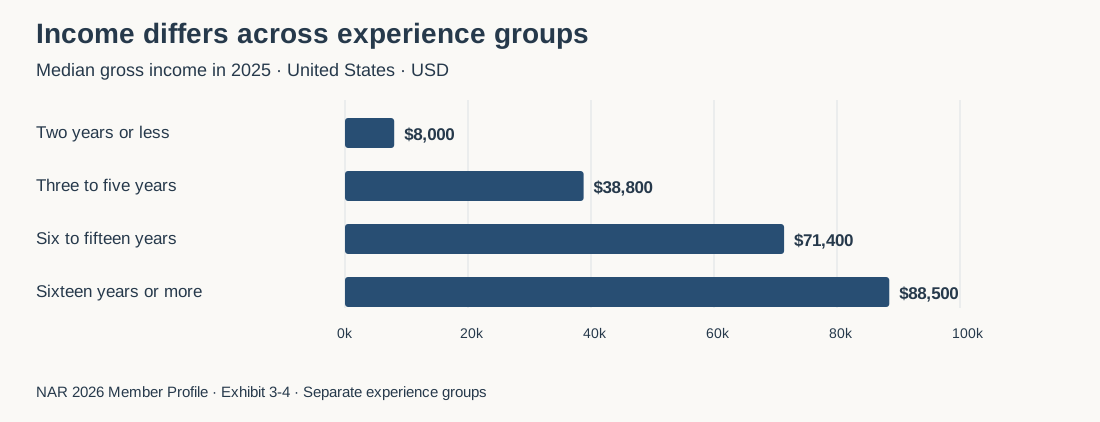
NAR also reports that 62% of members with two years of experience or less earned under US$10,000 in gross income.[1]
A median is the middle of the reported distribution. The all-member median therefore combines people at substantially different stages of their work. Quoting it to a new entrant without the experience breakdown leaves out context that could materially change their expectations.
The table is not a promise of progression. It compares different groups of current members, rather than following one group from its first year through a long career. The people who remain after sixteen years may differ from those who leave.
Build a first-year plan around the actual arrangement
A prospective agent can use this finding to make the conversation with a team or brokerage more specific. Start with the money that could reach the individual, the costs they would carry and the support that would help them develop clients.
| Question to ask | What the answer should clarify |
|---|---|
| How is my compensation calculated? | Personal receipts under the proposed agreement, including differences by business source |
| Which costs remain mine? | Recurring expenses, transaction expenses and services included in the arrangement |
| How will I develop clients? | The agent’s responsibilities, available opportunities and how those opportunities are allocated |
| What does coaching look like in practice? | Who provides it, how often and what work is reviewed |
| Who helps with a difficult transaction? | The specific support available when an issue needs attention |
| Whose earnings are used in your examples? | Whether examples describe all new entrants, active agents or selected successful individuals |
The final question is especially useful. An earnings example can be accurate while describing someone whose experience, existing relationships or workload is very different from yours. Ask for enough context to judge whether it is a reasonable comparison.
Plan for timing as well as totals
An annual income target does not explain when money arrives. A first-year plan should show how personal living costs and business expenses will be covered while opportunities develop and transactions proceed toward completion.
Use a range of outcomes instead of relying on one target. Work through what happens if the first transaction takes longer, fewer opportunities convert or expenses are higher than expected. The purpose is to understand how much room the plan has for ordinary uncertainty.
Gross income also needs to remain separate from money available for personal spending. NAR reports overall median net income after taxes and expenses of US$37,000, alongside the US$59,200 overall gross median.[1] These are separate survey statistics; subtracting them would not calculate a typical respondent’s costs. Your own budget needs its own expense and tax assumptions.
Where Ottawa evidence fits
Our Ottawa agent transaction study adds local evidence about the distribution of recorded activity among individuals with at least one transaction during its study period. It is useful context when evaluating production expectations.
It does not disclose personal compensation, expenses or working hours, and it does not include a complete population of agents with no transactions. A transaction count therefore cannot be turned into an income estimate simply by multiplying it by an assumed commission.
A credible career opportunity should be explainable through the work, the support and the economics of the agreement. The most useful role of the income survey is to prompt that discussion before an industry headline becomes a personal financial assumption.
Source and method
[1] National Association of REALTORS, 2026 Member Profile: PDF page 35, Exhibit 3-2, for overall gross and net income; page 37, Exhibit 3-4, for gross income by experience; page 79 for methodology. The March 2026 survey received 5,116 responses from 286,777 invitations, with an adjusted response rate of 1.7%, and was weighted by state. Financial results refer to 2025 and are self-reported in USD. The full sample is not the base for every experience group. Current-member participation, nonresponse and differences between groups limit interpretation. No causal effect of experience, Canadian income estimate or individual earnings forecast is calculated. Planning questions are editorial interpretation.
Published September 24, 2026. Survey income figures refer to 2025 and are in U.S. dollars.
Cite this article
Richling, Matt. New Purveyors Lab. “Why is the overall REALTOR income figure a poor budget for a new agent?” Published September 24, 2026. Article link.