Among respondents explaining a planned switch, 22.9% cited the previous agent retiring or no longer working in their city, 18.6% cited a bad experience and 15.1% cited moving to a different area.[1]
For a real estate team, those answers point to three different service questions: how to address a problem, how to support a move elsewhere and how to provide continuity when an agent becomes unavailable.
The next transaction was not automatically returning
In a filtered question about whom respondents intended to use when selling, 46% selected the same agent, 25% a different agent and 27% were unsure. A further 2% selected no agent.[1]
| Intended choice | Share |
|---|---|
| Same agent | 46% |
| Different agent | 25% |
| Unsure | 27% |
| No agent | 2% |
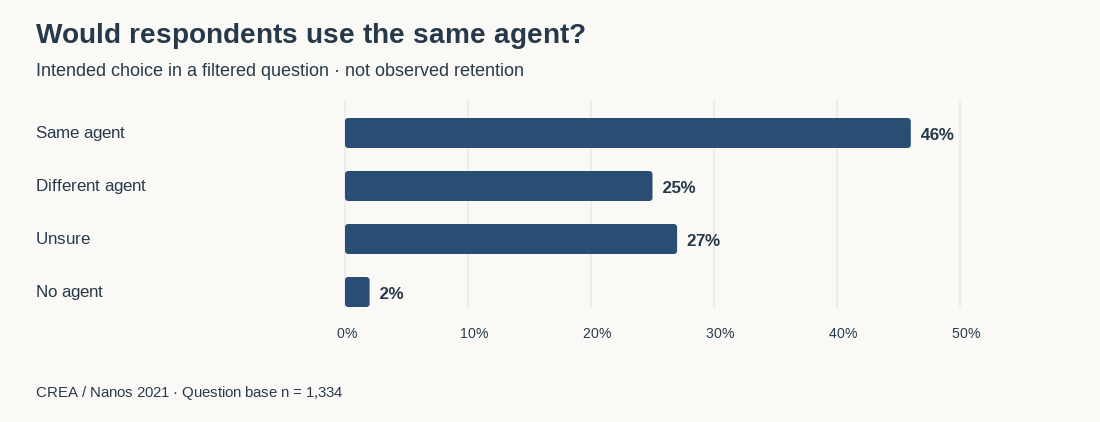
Question base: 1,334. These were intentions in a historical national survey, rather than observed client retention. The uncertain group should remain uncertain; it cannot be counted as either retained or lost.
Three reasons deserve three different conversations
The separate reasons question had 294 respondents planning to use a different agent. The following selected answers reveal why a single “lost client” label can be unhelpful.
| Selected reason for choosing differently | Share | Practical question for a team |
|---|---|---|
| Previous agent retired or no longer worked in their city | 22.9% | Does the client know whom to contact next? |
| Bad experience | 18.6% | What happened, and what needs to change in the service? |
| Moving to a different area | 15.1% | Can the client obtain help suited to the new location? |
The practical questions are our interpretation of the reported reasons, not tested retention interventions.
When the issue is service, ask for specifics. “We had a bad experience” can begin a useful review, but the team needs to understand the event or pattern behind it. What did the client expect? What happened? What would the team do differently on the next transaction?
When the issue is location, revisit the fit. A relationship developed around one property and neighbourhood may not cover the expertise needed for a later move. A useful conversation establishes what the client needs now and who is well placed to help.
When the issue is availability, make the next contact clear. A client whose agent has retired may still need assistance. Teams can explain who handles enquiries when the original agent is unavailable and how the client can reach that person.
Follow-up should have a purpose
A completed transaction provides a reason to ask what worked and what did not. A later conversation provides a reason to ask what has changed. Those are different conversations, and a routine message does not necessarily accomplish either.
For team leaders, the useful record is more specific than whether a past client replied. Capture what the person needs, whether there is an unresolved service issue and what next step was agreed. That creates something the team can act on.
For consumers, returning to a previous agent is a choice worth reconsidering in light of the next move. Ask how the agent’s experience fits the property, location and service you now need.
The survey does not show which follow-up programme works best. It does show why understanding the reason for a different choice is more useful than treating every choice as the same kind of rejection.
Source and method
[1] Nanos Research for the Canadian Real Estate Association, Satisfaction with REALTORS Hits New High During COVID-19 Pandemic, June 2021: PDF page 45 for reuse intentions, page 47 for reasons, pages 64–67 for methodology. The overall study comprised 2,021 Canadian adults with recent or intended buying/selling activity, surveyed May 3–30, 2021, with age and gender weighting and geographic stratification. The reuse question was filtered to respondents indicating they would use, or were already using, an agent to sell; it asked about the agent previously used to help buy a home. Question bases differ. Reasons are selected categories, not an exhaustive distribution. This historical national study does not measure current Ottawa retention.
Cite this article
Richling, Matt. New Purveyors Lab. “Why do clients plan to choose a different REALTOR?” Published September 28, 2026. Article link.