That distinction matters as Ottawa approaches January 2027 with a provincial rent-increase guideline, a tax-related reduction for eligible properties and a new rental-renovation licensing regime. The feed records do not determine which law applies to a tenancy.
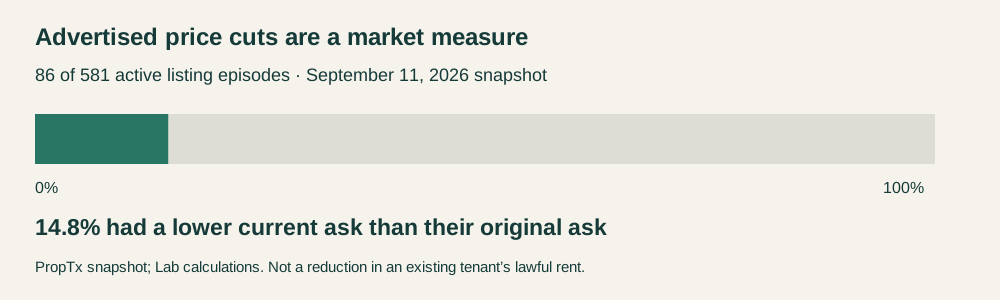
Market prices and legal rules measure different things
| Measure | What the available evidence shows | What it does not establish |
|---|---|---|
| Net asking-price reduction | 86 of 581 active PropTx episodes had a lower current ask than original ask | A reduction in an existing tenant's lawful rent |
| Rent-increase guideline | Ontario has announced a 1.9% guideline for 2027 | A required increase or universal coverage of every tenancy |
| Tax-related rent reduction | The City has announced a program affecting eligible properties | Eligibility or the exact new rent for every household |
PropTx figures use the restricted samples defined below. The rows measure different processes and should not be combined into one rate.
Our listing data can describe observed asking-price changes. The net comparison does not reveal when a price was reduced or every intermediate change. Unconfirmed residential closing-price comparisons are excluded. It does not include the property-specific tax notices or legal determinations needed to calculate an affected tenancy's rent.
Ontario's guideline is a separate rule
Ontario's announced 2027 guideline is 1.9%, compared with 2.1% in 2026. It limits increases for most covered tenancies without Landlord and Tenant Board approval; it does not require an increase. Exemptions apply. In most cases, increases require at least 12 months since the tenancy began or the last increase and proper written notice at least 90 days in advance. Ontario: residential rent increases
The date, notice and tenancy's coverage matter. The fact that advertised asking prices are falling somewhere in the market does not by itself determine the lawful rent for an occupied unit.
Ottawa has announced another tax-related reduction
The City's April 8, 2026 council announcement said its tax-policy change would trigger an automatic rent reduction for about 57,000 tenants in multi-unit apartment buildings on January 1, 2027. It described an approximate 0.7% reduction, illustrating $13.90 monthly on $2,000 rent. City of Ottawa: approved 2026 tax policy
Those are program announcements, not measured savings already received by all affected households. The exact property-specific information matters; the rounded percentage and dollar example should not replace an individual notice or applicable order.
If a tenant receives both reduction and increase notices, the amounts and effective dates need to be reconciled. Subtracting the two headline percentages is not a sufficient calculation.
The renovation licence addresses a different issue
Ottawa's July 2026 update says its Rental Renovation Licence By-law takes effect January 1, 2027. It describes municipal requirements for covered renovation-related terminations, including an information guide, a licence application within seven days of the termination notice and building-permit requirements. It does not replace the provincial eviction process. City of Ottawa: rental-renovation update
The adopted by-law sets out scope and exceptions. It should not be read as requiring this licence for every repair or as making a municipal licence an eviction order. City of Ottawa: By-law 2026-348
The current sample cannot measure a future policy's effect
These rental observations were extracted in September 2026, before the announced January 2027 measures take effect. They cannot demonstrate an effect of those measures. Even a later change in asking prices would require analysis of other market changes before attributing it to policy.
A useful follow-up would track eligible households notified, verified reductions applied, licence applications and relevant enforcement outcomes. Those administrative and household measures answer questions that an MLS listing snapshot cannot.
For now, keep market comparisons and legal notices in separate parts of the decision. Recheck the applicable official guidance at publication and seek qualified advice for an individual tenancy where needed. Policy information was rechecked against official sources September 19, 2026. The market snapshot remains dated September 11.
Source and methodology
Source: New Purveyors Lab calculations from the PropTx VOW snapshot extracted September 11, 2026, at approximately 1:17 p.m. Toronto time. “Ottawa region” means the feed's CountyOrParish=Ottawa filter; equivalence to municipal or metropolitan boundaries has not been established.
The comparison includes only listings explicitly marked Entire Property, Unfurnished and 12 Months, with positive original/current asking prices, in four groups: single detached, freehold townhouse, apartment condominium and townhouse condominium. The broad active extraction contained 1,083 records; 581 met these criteria. These are listing episodes, not independently deduplicated homes or a census of Ottawa rentals. Other valid rental types and some self-contained units are excluded.
Prices are not standardized for location, size or inclusions. Counts and response hashes were verified. Percentages and medians use unrounded inputs; displayed values are rounded. The owner confirmed on September 14 that active asking prices are monthly; the provider frequency field remains blank. The percentage comparison does not depend on presenting closing amounts as agreed rents. Read the asking-price reduction study and our research standards.
Cite this article
New Purveyors Lab. “How do Ottawa rental price cuts differ from the rental rules changing in 2027?” Published September 19, 2026. Article link.