Archived edition · View the latest edition
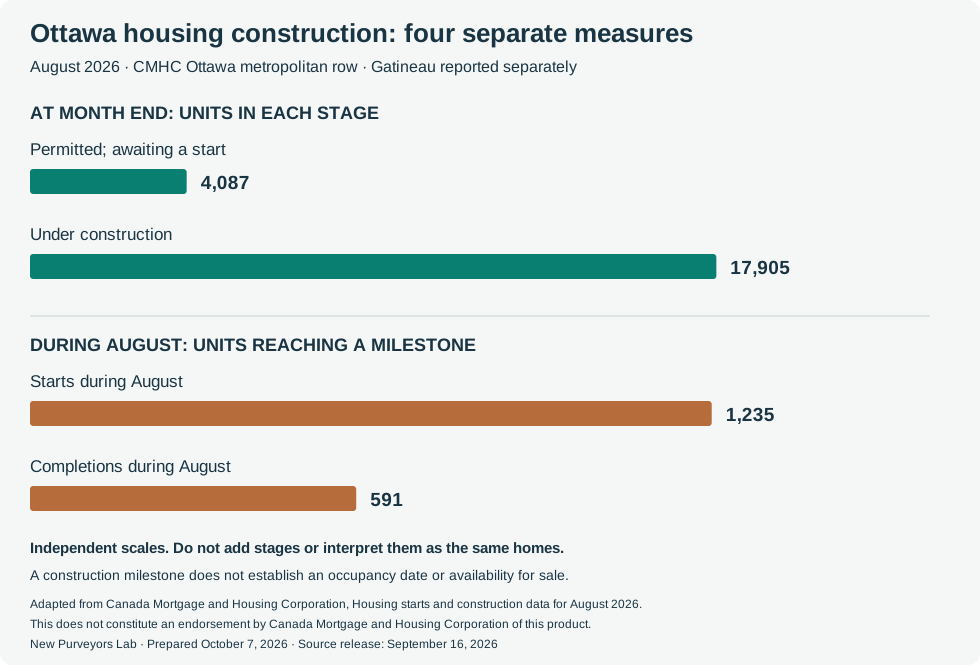
For someone comparing Ottawa neighbourhoods, the useful question is what kind of housing could arrive nearby, how far it has progressed and whether it matches their needs. A large regional pipeline provides context. The answer for a particular street requires checking the individual project.
Four measures to keep separate
| Measure | August 2026 | What the number describes |
|---|---|---|
| Permitted units awaiting a start | 4,087 | Units with approved building permits, excluding conversions, where construction had not yet been observed |
| Housing starts | 1,235 | Construction beginning during August |
| Homes under construction | 17,905 | Unfinished units at the end of August |
| Housing completions | 591 | Units reaching CMHC's completion stage during August |
These are the Ottawa row in CMHC's metropolitan tables, where Gatineau is reported separately. They cover a broader geography than the City of Ottawa. The same release reports 7,254 starts from January through August 2026, compared with 6,694 during the same months of 2025. CMHC tables and footnotes
A start generally means the foundation footing has been poured, or an equivalent stage reached. A completion is a construction milestone; CMHC can count a dwelling as complete with up to 10% of the work outstanding. Under-construction counts also allow for adjustments, such as changes to the number of units in a project. CMHC methodology
Adding starts, unfinished units and completions would mix monthly activity with a snapshot of ongoing work. Nor can we divide this month's completions by this month's starts to calculate a delivery rate: the completed homes usually began earlier. An occupancy date requires separate evidence.
What does an approval establish?
Ottawa's housing approvals dashboard separates land-use permissions, detailed development approvals and building permits. Its definitions distinguish changes to planning policy or zoning from site-plan and lot-creation processes. Some development can proceed directly to a building permit under existing permissions. A permit authorizes construction or a change of use; it does not establish that work has begun. City definitions
That distinction changes how we read a development headline. A proposal submitted for review, a permitted building and a completed building offer different levels of information about future housing. The same project can appear in more than one dataset as it advances. A neighbourhood report needs to identify those overlaps before counting units.
The City's dashboard supports exploration by ward, dwelling type and reporting period. Those filters are useful starting points, provided the chosen geography and dates remain visible beside the result. About the dashboard
A local example: checking the record behind a proposal
The City's record for 3285 Borrisokane Road, application D07-12-24-0097, describes a site-plan application for 196 stacked townhouse units. The retrieved public record showed an application status of Post Approval and a review status of Request for Agreement Received, dated February 4, 2026. It also listed approved documents dated January 21, 2026. Those are planning-record facts, rather than confirmation of a construction start or completion. City application record
For a buyer interested in that location, the next research step is to check subsequent documents and separate permit or construction evidence. The record's status date should travel with any summary: a page retrieved in October can contain a status last updated months earlier. An older application description also needs checking against later approved plans before treating every detail as final.
The City's 2025 development growth ward maps, released in 2026, can help locate other files. They depict applications under review and dwellings with permits in a historical snapshot. The City explicitly cautions that projects may not proceed and that the maps do not measure completed housing. Use them to discover addresses, then check newer records. City map methodology
The kind of housing matters to your decision
CMHC's Fall 2026 Ottawa analysis describes a pipeline dominated by purpose-built rentals, with condominium development facing weak presales and financing challenges. That helps explain why a substantial construction pipeline can coexist with a more limited pipeline of ownership options. CMHC Fall 2026 report
For a condo purchaser, a nearby rental project and a new condominium launch belong in different parts of the comparison. For a townhouse buyer, the number of bedrooms, ownership form and usable space still matter. Regional unit totals cannot tell either person what will meet their budget or become available before their move.
When assessing a home, I would organize the development questions around three things: the relevant addresses, the latest documented stage of each project, and the specific implications to investigate for that purchase. This keeps a discussion about changing surroundings connected to the property being considered, without turning a regional statistic into a claim about its future price.
Sources, timing and scope
This edition uses CMHC's August release, published September 16, 2026. It lists October 16 as the scheduled release date for September construction data. September resale results therefore do not make a complete Q3 construction series available on October 7. Release calendar note
The table uses actual units, not seasonally adjusted annual rates. Municipal application records and metropolitan construction totals are presented separately; no project-level matching or neighbourhood supply total is claimed. Construction counts include multiple intended markets and do not measure net housing-stock growth, current listings or price effects. The application example was selected to illustrate source interpretation, not to represent all development activity.
Adapted from Canada Mortgage and Housing Corporation, Housing starts and construction data for August 2026 and Fall 2026 Housing Supply Report, August 2026 and first-half 2026 reference periods. This does not constitute an endorsement by Canada Mortgage and Housing Corporation of this product. CMHC data licence
Comparing a home or neighbourhood? Ask Matt Richling to help put the relevant development records alongside comparable homes, your budget and your moving timeline. Contact Matt
Discuss these findings
For help applying these findings to a property or a move, contact Matt Richling. Include the area, property type and timing that matter to you.
Cite this edition
Richling, Matt. “What does Ottawa's housing construction pipeline tell buyers in October 2026?” New Purveyors Lab. August 2026 construction · October 2026 edition. Updated October 7, 2026. Permanent edition.