A useful starting point for two different searches
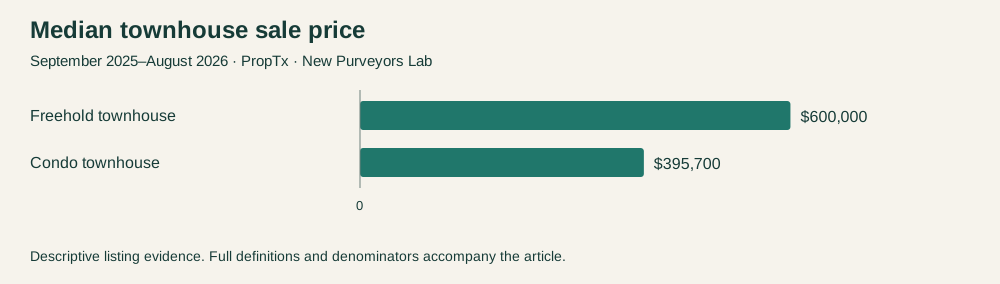
The purchase-price gap is substantial enough to affect which homes enter a buyer's search. But “townhouse” does not make two properties directly comparable. The groups can differ in size, bathrooms, location, age and the buildings represented in the year's sales.
| Measure | Freehold townhouse | Condo townhouse |
|---|---|---|
| Sold episodes | 2,691 | 1,180 |
| Median sale price | $600,000 | $395,700 |
| Median above-grade bedrooms | 3 | 3 |
| Valid positive bedroom counts | 2,691 | 1,091 |
| Median bathrooms | 3 | 2.0 |
| Most common reported size band | 1500-2000 | 1200-1399 |
| Median monthly condo fee | Not measured | $471.00 |
| Positive condo-fee records | Not applicable | 1,179 |
The bedroom median uses positive reported above-grade counts. Missing or zero counts are excluded; that matters particularly for the condo group. Size categories are the provider's approximate square-footage bands and are not interchangeable exact measurements.
What the gap does—and does not—measure
The $204,300 figure is the difference between two annual medians. It is not a quote for converting a particular condo townhouse into an otherwise identical freehold home. We attempted a tighter comparison within the same provider area, bedroom count, exact size band and calendar quarter. No groups met the minimum overlap rule, so this study does not publish an adjusted tenure premium.
The raw table remains useful as a description of the homes that traded. It shows that the typical recorded freehold sale came from a different housing mix, including a different modal size band and bathroom count. Those differences should remain beside the headline price gap.
Compare the purchase and the recurring commitment separately
The monthly condo fee is another observed figure, not a complete ownership budget. Its amount alone does not describe the services provided or the corporation's financial position. Equally, the lack of an AssociationFee value on the freehold records does not establish that owning those homes carries no shared charges or maintenance expenses.
A practical comparison starts with specific properties, their asking prices and the obligations attached to each. This article does not turn the difference into a mortgage payment, investment return or universal break-even period. Those calculations require information that is not in this study.
The result is a clear benchmark for deciding whether to investigate both categories: they shared a housing label but occupied quite different purchase-price ranges in the observed year.
Source and methodology
Source: PropTx VOW, extracted September 19, 2026 (Toronto). Unless stated otherwise, purchase-contract dates run from September 1, 2025 through August 31, 2026. The four-category annual sample contains 10,476 sold listing episodes: detached houses, freehold townhouses, apartment condominiums and condominium townhouses. Other property types are excluded. The geography is the provider's CountyOrParish=Ottawa; its City labels describe market areas, not independently verified neighbourhood boundaries.
These are episodes visible in a dated feed, not a census of unique homes. Relistings are not joined, and subsequently withheld records may be absent. Sold-only results do not measure the probability that a newly listed home sells. Asking prices are seller-selected reference points, not appraisals of market value.
Medians use valid numeric observations without outlier trimming. Price and fee values must be positive. Each table identifies its denominator, and medians require at least 30 valid records. Size bands remain approximate provider categories, with no conversion to exact square footage. Monthly condo-fee interpretation was confirmed by the project owner on September 14. No individual property valuation or causal effect is established.
Source-response fingerprints, page counts and unique episode keys were checked. The attempted comparison required matching City, BedroomsAboveGrade, exact LivingAreaRange and calendar quarter, with at least three episodes on each side per group and 30 retained episodes on each side overall. No eligible groups were found. The feed uses different size-band systems for freeholds and condos, which limits exact-band matching. Read the Lab’s research standards for our publication approach.
Study period: September 1, 2025–August 31, 2026. Source snapshot: September 19, 2026 (Toronto). Published September 26, 2026. Prices are Canadian dollars and condo fees are monthly.
Cite this article
Richling, Matt. New Purveyors Lab. “How much more did a freehold townhouse cost than a condo townhouse in Ottawa?” Published September 26, 2026. Article link.