The two findings are a useful prompt for anyone paying for a site: define the job it is meant to do and the evidence that would count as success.[1][2]
A website’s existence is easy to establish. Its contribution to a business takes more work to understand.
What members reported
| Source of business | Median reported share in 2025 |
|---|---|
| Agent website | 0% |
| Social media | 3% |
| AI search | 0% |
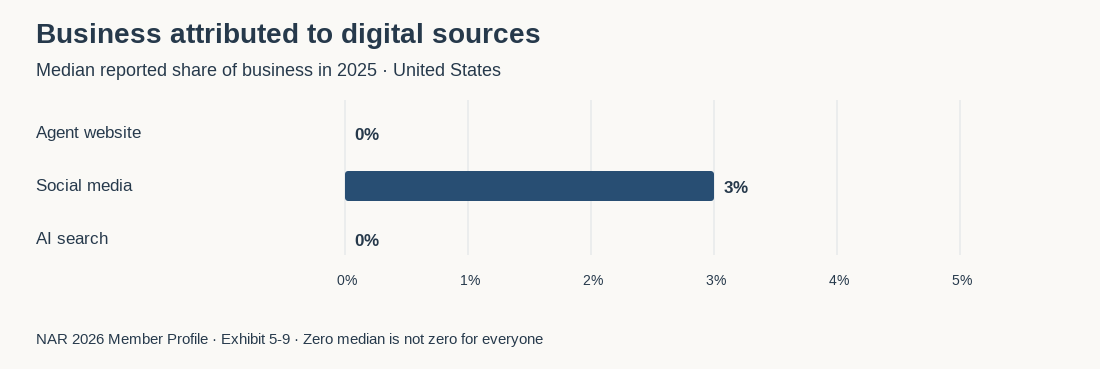
NAR also reports a median of zero annual website enquiries in the same detailed table.[1] A zero median does not mean nobody generated business. It describes the middle of the reported distribution, not every respondent’s result or the total business generated across the sample.
Nor does the survey test whether a specific website caused more transactions. It records what members attributed to the channels. That distinction matters when setting a budget or evaluating a supplier’s promise.
Give the website a job you can evaluate
A site may be intended to introduce an agent, help a referred prospect assess their experience, answer a local property question or produce a relevant enquiry. Each purpose calls for different evidence.
| Intended purpose | Evidence worth collecting | What that evidence establishes |
|---|---|---|
| Reach people researching a local question | Visits to relevant pages and how people found them | Whether the material is being discovered |
| Help someone evaluate the agent | Enquiry feedback about which information helped | The role readers say the material played |
| Generate conversations | Relevant enquiries, with spam and duplicates separated | Opportunities to discuss an actual need |
| Develop client relationships | Which enquiries become clients, tracked over an appropriate period | Business associated with those recorded enquiries |
This is a proposed measurement framework, not a set of conversion benchmarks from NAR. It keeps the evidence attached to the purpose. A rise in page visits can be encouraging without establishing a rise in clients.
Separate discovery from the decision to contact
Consider a hypothetical buyer who gets an agent’s name from a friend, reads a local research article on the agent’s site and then calls. The referral explains how the buyer first heard the name. The article may help explain why they decided to contact that agent.
A single source field can miss that distinction. Two questions are more informative: “How did you first hear about us?” and “What helped you decide to get in touch?” The answers will still be imperfect, but they allow the person to describe more than one influence.
That does not justify assigning every referral to a website. It gives a team a way to investigate the site’s supporting role instead of simply assuming one.
Ask a supplier to connect the proposal to the outcome
Before commissioning more pages, a redesign or additional traffic, ask what problem the work is expected to solve. How will a relevant reader find the page? What will they learn? What action should be easier afterwards? How will the result be recorded?
If the proposal promises leads, clarify what qualifies as one. If it promises visibility, clarify where and how that visibility will be observed. For an existing site, compare the proposed work with evidence about what readers currently do and what enquiries actually arrive.
NAR’s figures make automatic expectations hard to defend. A useful website decision starts with a specific purpose, a credible path for the reader and a way to examine what happens next.
Sources and method
[1] National Association of REALTORS, 2026 Member Profile, PDF page 55, Exhibit 5-9. Figures above follow the detailed table, with each median kept as a separate measure; the three percentages are not added together. [2] Same report, PDF page 51, website ownership table. Methodology is on PDF page 79: 5,116 U.S. member responses in March 2026, an adjusted 1.7% response rate and state weighting. Activity refers to 2025. Results are self-reported, describe U.S. members and do not measure an Ottawa website’s conversion rate or the causal return on marketing spending.
Published September 27, 2026. Business-activity findings refer to 2025; website ownership reflects the March 2026 U.S. member survey.
Cite this article
Richling, Matt. New Purveyors Lab. “What should an agent website deliver—and how would you know?” Published September 27, 2026. Article link.