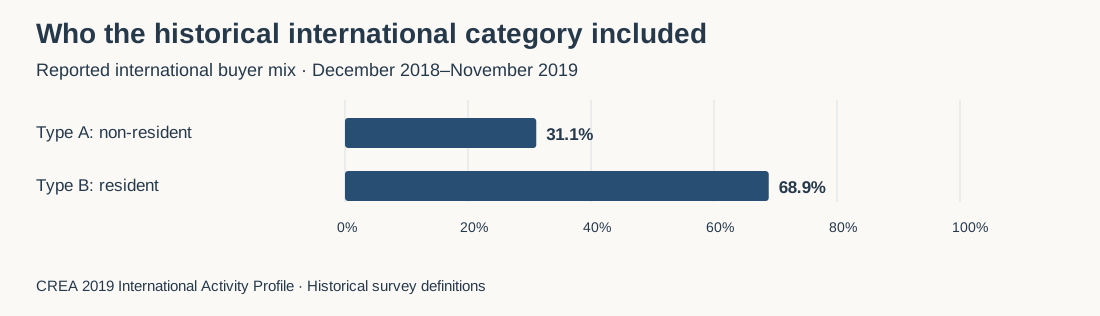
That group represented 68.9% of the reported buyer mix, compared with 31.1% in the non-resident category.[1]
The definition changes how the finding should be understood. A recently arrived household buying a place to live could fall within the report’s international category. Describing the whole group as overseas investors would erase that distinction.
What the categories included
CREA divided international clients into two groups, both defined around non-Canadian citizenship with additional residence criteria.
| Report category | Definition | Reported buyer mix |
|---|---|---|
| Type A: non-resident | Non-Canadian citizens with a permanent residence outside Canada | 31.1% |
| Type B: resident | Non-Canadian citizens who had been in Canada for less than two years at the time of the transaction, or temporary visa holders living in Canada for more than six months for work, education or other reasons | 68.9% |
These are the study’s historical definitions. They are not a shortcut for deciding who qualifies under a current law or tax rule.
Intended use answers a different question
The report separately states that 55.6% of the international purchases it describes were intended as primary residences.[1]
Residence category describes the buyer; intended use describes the property’s role. The two measures should remain separate. The published summary does not establish exactly how many Type B buyers bought a primary residence, so combining the figures to produce that number would be unjustified.
For a reader, the distinction provides a useful habit: before accepting a label such as “investor,” look for the measure that actually establishes investment use. Citizenship or residence alone may answer a different question.
Check what the percentage is a share of
The 31.1% non-resident figure is a share of the international buyer mix reported by the study. It is not a finding that non-residents purchased 31.1% of all Canadian homes.
This is an easy distinction to lose when a number is separated from its table. The population named in a headline should match the population behind the percentage. The same rule applies to a neighbourhood, a property type or any other selected group.
The evidence here also comes from a member survey, not a census of land registry transactions. CREA received 9,046 member responses overall, with different questions applying to different subsets. That total should not be presented as the number of buyers behind every result.
A four-question check for a housing statistic
This report provides a concrete example of how to examine a claim before repeating it:
1. Who is included? Here, the definition includes both specified resident and non-resident groups.
2. What behaviour is measured? Buying a property, intending it as a primary residence and holding it as an investment are different characteristics.
3. What is the denominator? The international category is a subset, not the whole Canadian market.
4. When did it happen? These responses describe activity from December 2018 through November 2019.
For an Ottawa buyer or seller, those questions help determine whether a national statistic has anything useful to say about a local decision. This report alone cannot establish present demand in a neighbourhood or explain a change in its prices.
Its lasting value is a precise historical finding and a useful reading lesson: know whom the research counted before deciding what the count means.
Source and method
[1] Canadian Real Estate Association, 2019 Profile of International Activity in Canadian Real Estate, prepared by Framework Partners Inc.: PDF page 6 for definitions and methodology; pages 7–8 for the summary buyer mix and primary-residence finding. Fieldwork ran from December 2019 into early January 2020 and asked about the preceding December–November period. The survey received 9,046 member responses, a reported 6.9% response rate. Question-specific bases differ; no full-sample margin of error is applied to these subgroups. This article paraphrases the report’s historical definitions and makes no current legal or causal price claim.
Cite this article
Richling, Matt. New Purveyors Lab. “Did “international buyer” mean an overseas investor in CREA’s 2019 report?” Published September 30, 2026. Article link.