NAR’s newer U.S. research shows a substantial difference in repeat and referral business between its newest and most experienced members.[1][2]
The practical question is how an agent develops the first client relationships that could eventually support a referral business.
Referrals led the Canadian survey
CREA asked members to identify their primary source of leads. Referrals were selected much more frequently than any of the individual digital channels shown below.
| Selected primary lead source | Share naming it first |
|---|---|
| Referrals | 61% |
| Social media | 5% |
| REALTOR.ca | 4% |
| Brokerage website | 4% |
| Personal website | 3% |
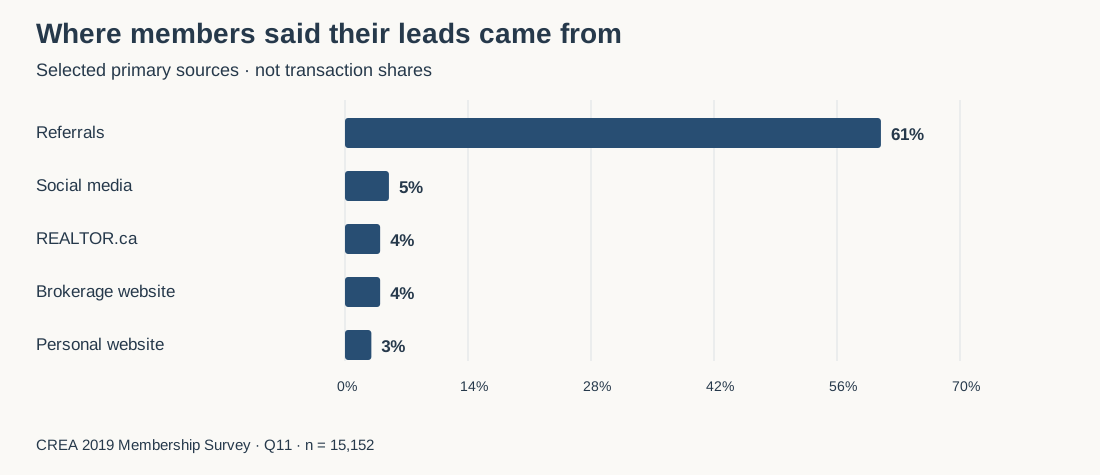
Source: CREA’s 2019 member survey, 15,152 respondents. These are selected categories. The 61% describes agents naming referrals first, rather than the share of all transactions generated by referrals.[1]
The result gives referrals a clear place in a business-planning conversation. The experience breakdown in the U.S. survey makes that conversation more specific.
An established client base changes the starting point
NAR measures the percentage of business members attribute to repeat clients and referrals from past clients and customers. Its 2026 report gives the following medians for 2025:
| Experience group | Median share from repeat clients | Median share from referrals |
|---|---|---|
| Two years or less | 0% | 0% |
| Sixteen years or more | 49% | 32% |
Each column is a separate measure; the medians should not be added. These U.S. results describe different groups of current members, rather than a guaranteed path from newcomer to established agent.[2]
An experienced agent recommending that someone “work their database” may be describing a business supported by years of completed transactions. A beginner may have personal relationships, but few past clients who have experienced their real estate service. That difference should be visible in the plan.
Ask what happens before the referral
When evaluating a team or brokerage, ask how a new agent will have meaningful conversations with potential clients. What opportunities are available? How are they allocated? What is the agent expected to create independently?
Then ask how the agent learns to turn an opportunity into useful service. Who reviews a pricing analysis? Who helps prepare for a buyer consultation? What happens when an enquiry raises a question the agent cannot yet answer confidently?
Those questions connect client development with competence. A contact list alone says little about whether an agent can help the people on it, and a promise of leads needs enough detail to judge what work and support sit behind it.
Make the first relationships worth continuing
Our practical recommendation is to give a new agent’s plan two connected parts: creating opportunities to serve clients and doing the work well enough that those relationships have a reason to continue.
For the first part, define the activity and responsibility. An open house, an introduction or an enquiry is a starting point; the plan should identify who follows up and what help they can offer.
For the second, review the actual work. Can the agent explain the evidence behind an offer? Do clients know the next step? Are questions answered and commitments kept? These are coaching questions, not survey-proven tactics for increasing referrals by a specified amount.
The survey findings make a strong case for asking about referrals. They also make it worth asking how a new agent will earn the first recommendation. A career plan should explain both.
Sources and method
[1] Canadian Real Estate Association, 2019 Membership Survey, PDF page 40, question 11; methodology pages 13–16. Survey conducted February 27–March 28, 2019; 15,152 responses, 11.36% response rate, weighted by board/association. Figures describe self-reported primary lead sources among members, not tracked consumer journeys or completed transaction shares.
[2] National Association of REALTORS, 2026 Member Profile, PDF page 30, Exhibits 2-17 and 2-18; methodology page 79. U.S. survey conducted in March 2026 about 2025 activity, with 5,116 responses and an adjusted 1.7% response rate; results weighted by state. Experience-group differences are descriptive and may also reflect differences in work patterns, specializations and who remains in membership. Canadian and U.S. measures are presented separately.
Published September 25, 2026. Canadian findings refer to the 2019 survey; U.S. business shares refer to 2025 activity reported in 2026.
Cite this article
Richling, Matt. New Purveyors Lab. “How should a new agent build a business before repeat clients arrive?” Published September 25, 2026. Article link.